Scale Ingredients for an Air-Fryer Recipe Without Scaling the Basket Beyond Its Limit
Doubling ingredient quantities does not double the appliance’s usable cooking space. Scale the preparation formula separately from the load, cooking process and service plan. A clear calculation keeps the arithmetic correct while leaving the equipment constraints visible.
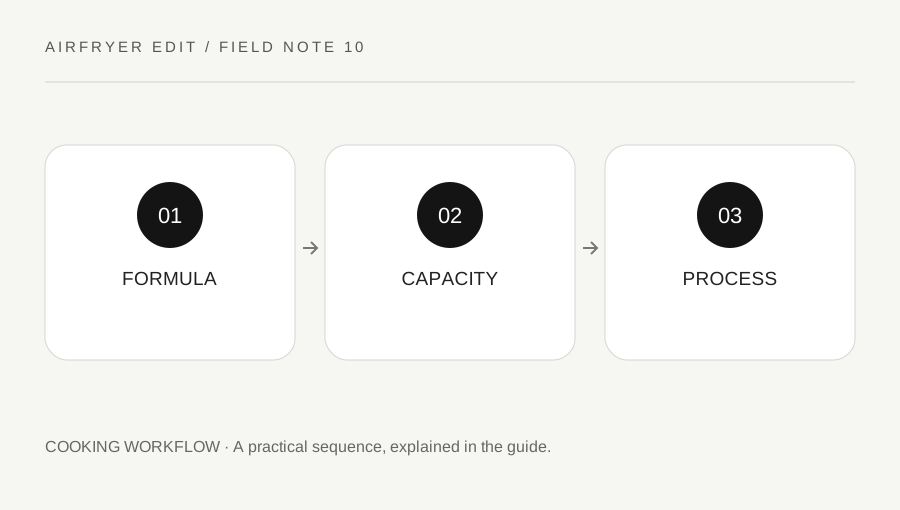
Original explanatory diagram. Examples illustrate a method or decision; they are not claims of personal testing.
Calculate the preparation factor
Divide the desired portion count by the original portion count to obtain a scaling factor, provided the recipe's portion definition is suitable. Multiply measured ingredient quantities by that factor. Keep units consistent and distinguish weight, volume and count-based ingredients.
For an illustrative recipe serving two, preparing four gives a factor of two. A listed 300 grams of a main ingredient becomes 600 grams. This arithmetic does not establish a new cooking time, a suitable basket load or the right amount of every finishing seasoning. Follow the supported recipe's scaling guidance where it provides one.
Plan appliance batches separately
Compare the scaled food with the actual model's permitted load and the recipe's arrangement. A single layer can become two separate batches even when the total weight is below an advertised maximum. Thick pieces, dishes and mixed ingredients need their own assessment.
Do not double the timer simply because the ingredient weight doubled. Nor should you assume the same time applies to an overcrowded basket. Use supported loads and methods, then verify the appropriate food endpoint. Keep uncooked perishable portions refrigerated while earlier batches cook.
Handle small quantities and finishing ingredients
A scale can make proportional quantities easier to measure, but use one appropriate to the amount and precision. Count-based ingredients may need a recipe-specific approach rather than an arbitrary fraction. Seasoning and sauce can be adjusted at an appropriate safe stage according to the recipe and dietary needs.
Do not reduce a safety-critical process in the name of proportional scaling. Required internal temperatures do not halve for half a batch. Product directions, allergen information and appliance clearances remain relevant. Separate a mathematical formula from a validated cooking process in both your notes and any published explanation.
Work through a four-portion plan
Imagine a supported two-portion preparation that occupies the basket correctly. For four portions, scale suitable ingredient quantities by two, then prepare two supported loads. Arrange a safe service or verified hot-holding method for the first load and keep the second raw portion properly chilled.
Record actual piece sizes, load and endpoint checks after a genuine cooking session. If you change the product or cut thickness, reassess the process rather than treating the old timer as a permanent rule. This guide supplies arithmetic and planning distinctions, not a tested larger-batch recipe. The result should be a reproducible preparation plan with equipment limits still visible.
Keep a three-column scaling sheet
Use columns for original ingredient amount, scaling factor and planned preparation amount. Add a separate section for basket loads. For example, a factor of two can produce twice the ingredient quantity while leaving each supported load unchanged. The number of loads changes instead.
Check count-based items and very small quantities against the recipe guidance. A kitchen scale's displayed precision does not guarantee that every tiny measurement is accurate. Keep finishing adjustments and safety endpoints out of the proportional arithmetic. If a recipe has not supplied a supported larger process, label your sheet as a preparation plan rather than a tested scaled recipe. After a genuine session, record actual loads and checks separately. This format makes the mathematical part reviewable without implying that multiplying ingredient amounts has validated a new appliance process or a longer unsupported holding period.
A practical checklist
Choices are saved in this browser. Reset them here or clear this site’s browser storage.
Questions that come up
Should I double cooking time for twice the ingredients?
Not as a general rule. Divide into supported loads or use verified guidance for the changed process, and check the required food endpoint.
Can a half batch use half the safe temperature?
No. Food-safety endpoints do not scale down with portion count. Follow the guidance for the actual food category.
Why record piece size as well as grams?
Shape and thickness affect the cooking arrangement and checks. Equal weights can occupy different space or have different centres, so weight alone does not describe the process.
References & scope
Background references checked on 18 October 2026. Worked examples and diagrams are original teaching material.