Air-Fryer Liners and Accessories: Compatibility Comes Before Easy Cleanup
An accessory that fits inside the basket is not automatically suitable for the appliance. Materials, temperature limits, air paths and secure placement all matter. Use the actual model’s instructions rather than transferring a tip from another air fryer.
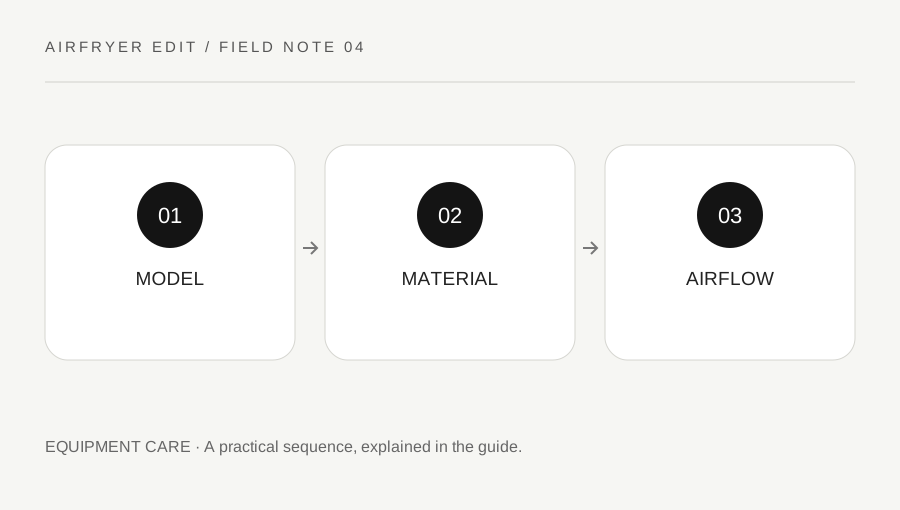
Original explanatory diagram. Examples illustrate a method or decision; they are not claims of personal testing.
Check the manufacturer’s recommendation
Find the manual and current support guidance for your model. Some manufacturers discourage particular liners or materials, while others supply specific accessories. Philips, for example, warns about loose baking paper or foil being drawn toward the heating element when used without food. This is a model-context warning, not permission to improvise a weighted liner in another appliance.
If the manufacturer says not to use a material, follow that instruction. A social-media demonstration does not override it. Do not use ordinary paper, packaging, plastic containers or an accessory with unknown heat suitability simply because it fits within the drawer.
Understand fit beyond dimensions
An accessory needs clearance for circulation and moving parts as well as room on the basket base. Check its intended position, maximum temperature and food-contact use. Oven-safe wording alone does not establish compatibility with every high-airflow appliance. Follow the accessory and appliance guidance together.
Avoid blocking vents or using a liner to cover a damaged basket coating. Do not preheat with loose lightweight material unless the manufacturer explicitly supports that exact setup. Handles, lids and silicone parts have their own limits. A mismatched accessory can affect heating even when it remains physically intact.
Keep food safety in the decision
A dish or liner can change exposure and heating compared with a bare-basket method. Follow a supported recipe or product process for that arrangement and check the appropriate internal food endpoint. An attractive browned top does not establish that a deeper dish has heated throughout.
For raw and cooked food, maintain separate clean handling. Remove the accessory using suitable protection and place it on a stable heat-safe surface. Do not balance a hot dish on a narrow basket edge. Plan how you will lift it before cooking, particularly if its handles become inaccessible when the drawer is full.
Use an accessory trial responsibly
Suppose an approved baking dish fits your model but leaves little space around its sides. Recheck the maker's required arrangement rather than assuming the physical fit is enough. If the intended recipe calls for a different dish depth or load, use that specification or choose another supported method.
Inspect accessories after cooling for damage and follow their cleaning instructions. Keep the part number and compatibility details with the appliance manual. This guide does not endorse a particular untested product. The useful sequence is compatibility, placement, food endpoint and safe handling, with easier cleanup considered only after those conditions are satisfied.
Keep a compatibility record for accessories
Store the accessory name, part number, supported appliance models and temperature limit with the manual. Include its cleaning instructions and any required placement diagram. A loose unlabelled tray in a cupboard can be mistaken for a compatible air-fryer part years later, especially when it resembles an ordinary oven dish.
Before use, inspect for cracks, warped shapes, loose handles or degraded material. Do not assume an item remains suitable merely because it was compatible when new. If a replacement accessory differs from the original, recheck the specification rather than transferring the old note automatically. A useful purchasing comparison asks about model support, circulation clearance, removal access and cleaning before considering colour or convenience. This record also makes it easier to contact the manufacturer with a precise question instead of asking whether an unidentified silicone or metal item is safe in every air fryer.
A practical checklist
Choices are saved in this browser. Reset them here or clear this site’s browser storage.
Questions that come up
Is oven-safe enough information?
Not by itself. Confirm compatibility with the actual air fryer, including airflow, placement, clearance and temperature limits.
Can I preheat with an empty paper liner?
Follow the manufacturer’s instruction. Loose lightweight material can move toward a heating element, and some makers specifically warn against it. Do not improvise a setup that the manual does not support.
Can a liner hide damaged nonstick coating?
No. Assess the basket condition with the manufacturer. A liner is not a repair for damaged food-contact equipment.
References & scope
Background references checked on 18 October 2026. Worked examples and diagrams are original teaching material.