Use a Food Thermometer in an Air-Fryer Meal: Find the Centre, Not the Basket
A thermometer measures where its sensing area is placed. Touching a hot basket or testing only a thin edge can produce a misleading reading. Identify the food category and the thickest relevant location, then follow the thermometer and appliance instructions.
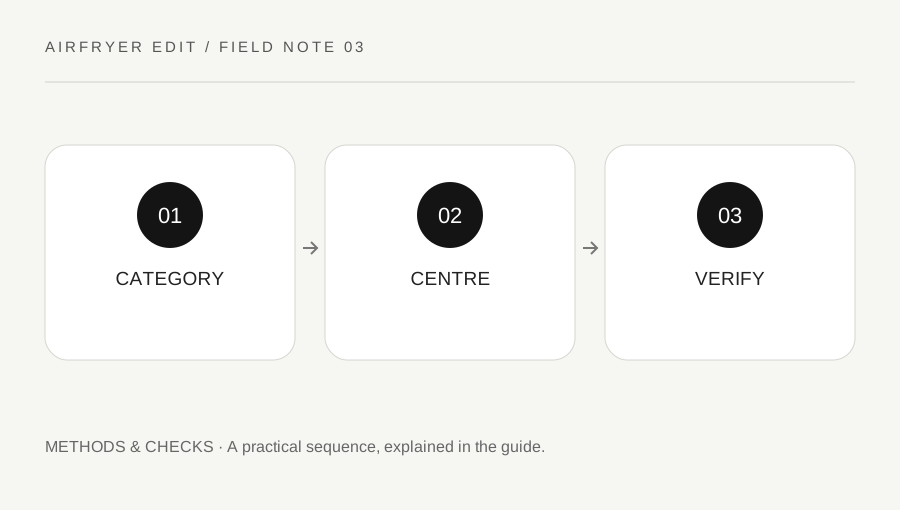
Original explanatory diagram. Examples illustrate a method or decision; they are not claims of personal testing.
Know the required endpoint
Consult current food-safety guidance for the ingredient and product. Under US guidance, poultry requires 165°F or 74°C; ground meat generally has a different minimum, while whole cuts can include a rest requirement. Leftovers also have their own reheating guidance. The appliance setting is not the internal food temperature.
Read product directions where they are more specific. A mixed dish or commercially prepared frozen item should not be classified casually from its appearance. Keep the package available and handle raw ingredients separately from ready-to-eat food. A safe measurement begins with knowing which requirement you are checking.
Place the sensing area appropriately
Follow the thermometer maker's guidance for insertion depth and sensing location. For an appropriate thick piece, check the thickest part without contacting bone, a metal basket or a hot tray. Thin foods can need a different insertion approach supported by the thermometer design. Do not assume the visible tip alone is always the entire sensing area.
Pause and access the food using the appliance's safe procedure. Protect against hot surfaces and steam. A leave-in probe is suitable only if both its design and the appliance instructions permit that use and cable routing. Do not trap an unsupported cable in the drawer or place plastic components in the heated chamber.
Check more than one representative point
Pieces can differ in size and position, so one reading does not automatically represent the whole load. Check appropriate thick pieces and locations, especially where heating may differ. If a required endpoint has not been reached, continue cooking through a supported method and recheck with clean handling.
Clean the probe according to its instructions between raw-food checks and ready-to-eat contact. Keep a clean plate and utensils for finished food. Do not return a cooked piece to a raw-food surface. Colour, a crisp coating and a timer alarm can support your process observations but cannot replace the actual required internal check.
Work through a misleading reading
Imagine inserting a probe through a thin edge until it touches the metal basket. The display rises quickly, but it may be reading the hot metal rather than the food centre. Reposition safely into the appropriate thick location using the thermometer's specified sensing depth and check other representative pieces.
If the corrected reading differs, treat the first as an invalid placement rather than averaging the two. Record the measurement method in any genuine cooking notes. This guide does not provide a new tested recipe or guarantee that one insertion fits every food. Accurate placement and the right endpoint make the number meaningful.
Check the thermometer before the meal
Read the thermometer's range, accuracy information and care instructions before cooking. If its maker provides an accuracy-check or calibration process, follow that method rather than improvising a test that could damage the probe. Check the display unit so Fahrenheit and Celsius are not confused.
Keep the probe clean and ready with a suitable place to set it down between checks. A thermometer buried in a drawer after raw-food contact is not ready for a cooked-food measurement. For a practice placement demonstration, use a safe nonfood model or the manufacturer's diagram to understand the sensing area before handling hot food. During cooking, protect hands and keep the appliance in a safe state for access. The purpose of preparation is a trustworthy measurement when needed, not a rushed search for an unfamiliar tool while the hot basket sits unprotected on the counter.
A practical checklist
Choices are saved in this browser. Reset them here or clear this site’s browser storage.
Questions that come up
Is the air-fryer display a food-temperature reading?
No. It controls or displays an appliance setting or chamber-related measurement, depending on the model. Use an appropriate food thermometer to assess the required internal endpoint.
Can I leave any probe inside?
No. Only use a probe and routing method approved for that appliance and temperature. Unsupported cables or plastic parts can be damaged or interfere with safe operation.
Should I average a hot edge and cool centre?
No. An average does not show that the required parts reached the endpoint. Use appropriate representative measurements and continue supported cooking when needed.
References & scope
Background references checked on 18 October 2026. Worked examples and diagrams are original teaching material.